Patent watch Disney Enterprises
Disney patent describes a wave that follows you without knowing who you are
A Disney patent application published October 8, 2026 describes screens, lights, speakers and floors that react to how a guest moves, while tracking only a few averaged, anonymous points for the head, torso and hands. Its showcase example is an animated ocean wave that turns to follow you and splashes when you raise both arms. It names no park, ship or opening date.
- Filed
- Apr 8, 2025
- Published
- Oct 8, 2026
- Status
- Application
Move across the screen. The wave watches.
The filing
What does Disney's body tracking patent describe?
The application is titled Anonymized Human Body Tracking, publication number US 2026/0310288 A1, filed by Disney Enterprises, Inc. of Burbank and listing six inventors. It opens with a balancing act. Interactive effects in public spaces have to respond with no lag a person can notice, but the data behind them should carry no personally identifiable information about the guests taking part. That goes for public spaces, and for private ones where guests "have not been asked to waive privacy rights."
The answer it describes can run on plain hardware. In some versions a single ordinary color video camera, with no depth sensor, watches a space. Others add more cameras, microphones or depth sensors. Software spots a person, finds a set of predetermined features, and averages them into one position per body segment. It then tracks how those few points move, sending updated positions about 60 times a second in the example given, and turns that into an effect.
The example
Where does the ocean wave come from?
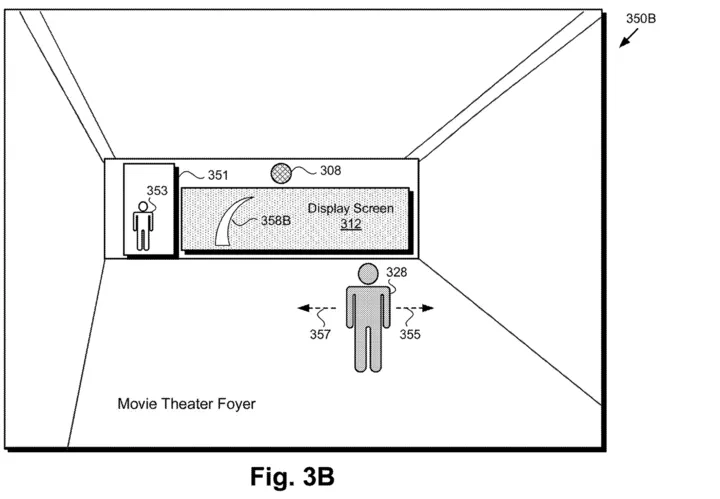
Figure 3B puts the system in a movie theater foyer. In the drawing, a poster for the film being shown hangs beside a screen, and a camera sits above the screen. On the screen is an animated ocean wave, described as a feature from the movie being promoted.
When the camera notices a guest, the wave is drawn so it appears to be looking at them. Walk one way and its gaze shifts to keep watching you. Raise both arms and, in the application's words, the wave "may appear to generate a splash of water." The filing never names the movie.
That foyer version is the stripped-down one. It uses only the camera and the screen.
The full room
What else can the room do?
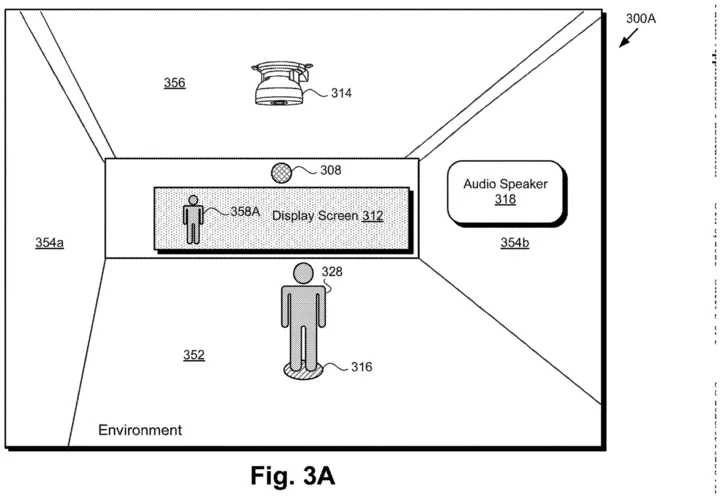
Figure 3A is the bigger version, and the one that sounds more like an attraction. Beside the screen, the room can fire three more kinds of effect.
- Ceiling lights such as small spotlights that switch, dim and brighten, in varying colors
- Haptics in the walls or under the floor, so a guest feels the effect where they stand
- Sound through an indoor or outdoor system, with theater quality Dolby surround given as an example
The application says all of these can be synced to the screen for "an immersive multi-media environment," and that the room does not need to be a controlled, prepared space the way many body tracking setups do.
The big question
Is this coming to Disney parks or cruise ships?
Nothing in the filing says so. These are the example places it lists, and it adds that the list is not complete.
Indoors
- Movie theater
- Concert hall
- Cruise ship common area
- Museum
Outdoors
- Open air sports stadium or arena
- The deck of a cruise ship
- Outdoor stage
- A park
Cruise ships show up twice, which fits a company that runs its own fleet. "A park" appears once, in a list of outdoor spaces, with no theme park named. The application names no Disney park, ship, attraction, opening date or partner.
Treat it the way you would any patent. Companies file for ideas they want to protect, and many never reach guests. This is also not a granted patent yet. US applications normally publish about 18 months after filing, which is why one filed in April 2025 is public now, and an examiner can still narrow or reject its claims.
The privacy angle
How anonymous is "anonymized" tracking?
This is the interesting part. The filing says conventional feature recognition can react fast enough, but "typically" breaks guest anonymity to do it. Its fix is to keep the average, not the face.
What the filing says
- Because it tracks averaged body segments rather than individually recognizable features, the position data "omits any PII," meaning any personally identifiable information.
- The system runs as a closed system, and that position data is not sent outside its own memory.
- Claims 2 and 12 make the no personal information point part of the claimed invention.
What it does not say
- How long the camera's raw video frames are kept, or where they go. The camera still has to see your face to find your eyes and ears.
- Whether any outside party would ever audit it.
- Claim 1, the main system claim, requires the averaging but does not itself spell out the no personal information rule.
So read it as a proposed design with privacy built into the description, not a verified guarantee. If a version of this ever shows up somewhere you can walk into, the posted signage and privacy policy for that space are what count.
The filing at a glance
- Title
- Anonymized Human Body Tracking
- Publication
- US 2026/0310288 A1
- Application
- 19/173,636
- Applicant
- Disney Enterprises, Inc.
- Filed
- April 8, 2025
- Published
- October 8, 2026
- Claims
- 20, two independent
- Examination
- Not confirmed by RDN
Read the full application on the USPTO publication PDF. The wave example is in paragraph 34, and the privacy language in paragraph 44 and claims 2 and 12.
Keep reading
More from the Desk
Disney's body tracking patent, answered
What is Disney's anonymized human body tracking patent?
It is US patent application 2026/0310288, published October 8, 2026 and filed by Disney Enterprises on April 8, 2025. It describes a camera system that averages a person's features into a few anonymous body points, tracks how those points move, and drives screen, light, sound or floor vibration effects in response.
Is this coming to Disney World or Disneyland?
Nothing in the application says so. It names no Disney park, ship, attraction or date. Its example is a movie theater foyer, and its list of possible places includes cruise ship common areas and decks, museums, stadiums and "a park" in general terms. Many patent applications never become a product.
Does the system recognize faces?
It looks for facial features such as eyes, ears, nose and chin, then averages their locations into one point for the head. The application says that averaged position data omits personally identifiable information and stays inside the system's own memory. It does not say what happens to the raw camera frames.
Is it a granted patent?
No. It is a published application. US applications are normally published about 18 months after filing, which matches this one's April 2025 filing and October 2026 publication. The claims can still change or be rejected during examination.
What happens when you raise both arms?
In the application's example, an animated ocean wave on a foyer screen appears to look at the guest and follows them as they move. If the guest raises both arms, the wave may appear to make a splash of water on the screen.